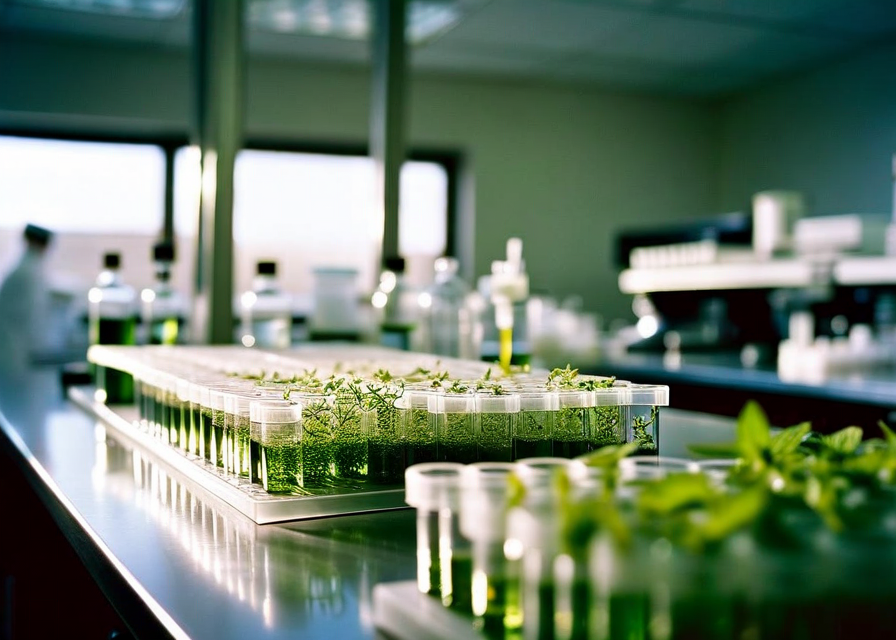
Most gene editing programs pick targets based on what is known about model organisms and hope the results translate to commercial crops. ClimateCrop's platform is built the other way around: we start with phenotypic variation that already exists in crop germplasm collections, trace that variation to specific genomic loci, and edit those same loci in elite adapted backgrounds. The result is a development pipeline with a substantially higher probability of producing commercially viable varieties — because we are not guessing which genes matter. We are editing genes whose function in real crop performance is already documented.
Step One: Mining Crop Germplasm for Natural Variation
The world's major genebanks hold hundreds of thousands of crop accessions — landraces, wild relatives, and historical varieties collected from farming communities across centuries. Within that diversity lies a substantial fraction of the phenotypic variation needed to address climate stress. A drought-tolerant landrace from the Sahel, a heat-stable wheat variety collected from a Pakistani valley with extreme summer temperatures, a deep-rooted rice variety identified in Philippine upland farming — these represent evolution's solutions to the same problems ClimateCrop is engineering for.
The challenge has always been connecting phenotypic performance to specific genetic causes. A drought-tolerant landrace may carry dozens of alleles that differ from elite varieties. Identifying which differences actually cause the drought tolerance, rather than simply correlating with it in that particular genetic background, requires sophisticated population genomics and functional validation. ClimateCrop's bioinformatics team uses a combination of genome-wide association studies (GWAS), quantitative trait locus (QTL) fine-mapping, and cross-species comparative genomics to identify candidate loci with high confidence before any editing begins.
The filter is strict: a locus advances to editing only when at least two independent lines of evidence support a functional relationship between that locus and the target phenotype. Typically this means strong GWAS association plus functional data from expression analysis or mutant characterization in a model species. This conservative approach accepts a slower target discovery process in exchange for higher success rates in the field — a trade-off that reflects hard-won lessons from the plant biotech industry's history of promising laboratory results that failed at commercial scale.
Guide RNA Design: Specificity as a Foundation
Once a target locus is confirmed, guide RNA design determines the specificity and efficiency of the edit. For CRISPR-Cas9, guide RNAs are 20-nucleotide sequences that direct the Cas9 endonuclease to a specific genomic site adjacent to a protospacer adjacent motif (PAM) sequence. In hexaploid bread wheat, which has three related genomes (A, B, and D), a single guide RNA may bind at multiple homeologous sites simultaneously — which can be either advantageous (if editing all three contributes additively to the phenotype) or problematic (if off-target editing at one homeolog disrupts yield-related function).
ClimateCrop uses a two-stage guide RNA screening process. First, computational prediction tools — including our internally developed pipeline that integrates CHOPCHOP, Cas-OFFinder, and genome-specific databases for the major crops we work in — score candidate guides for on-target efficiency and off-target probability. Only guides with predicted off-target scores below a defined threshold advance to experimental validation.
Second, candidate guides are validated in protoplast or callus systems using amplicon sequencing to measure on-target edit frequency and droplet digital PCR to detect off-target modification at the five highest-predicted off-target sites. This in vitro validation step adds three to six weeks to the development timeline but eliminates the discovery of off-target events in advanced field material — a far more costly outcome.
Editing Modalities: Choosing the Right Tool for Each Target
CRISPR-Cas9 with double-strand break induction is no longer the only tool in the plant gene editing toolkit, and ClimateCrop's platform selection depends on the nature of each target modification.
Knockout Editing (Cas9-Induced Indels)
For targets where loss of function is the desired outcome — silencing a negative regulator of drought response, for example, or disabling a susceptibility gene for fungal disease — Cas9-induced indels via NHEJ (non-homologous end joining) repair are the simplest approach. The resulting frameshift mutations are stable, highly heritable, and typically free of the foreign DNA integration concerns that complicate regulatory review. This modality is used in ClimateCrop's soybean disease resistance program, where disruption of the DMR6-1 susceptibility locus has produced consistent, high-level resistance to Phytophthora sojae across multiple field evaluations.
Base Editing
Base editors — fusions of a catalytically impaired Cas9 with a nucleobase deaminase enzyme — enable single-nucleotide changes without double-strand breaks. Cytosine base editors (CBEs) convert C·G base pairs to T·A, while adenine base editors (ABEs) convert A·T to G·C. This approach is used for targets where a specific amino acid substitution is required to alter protein function rather than eliminate it.
In ClimateCrop's heat tolerance program, ABE8e editing of a single adenine in the heat shock factor HSF4 binding domain produces a variant with altered thermal activation threshold — the protein activates the heat shock response at a slightly lower temperature than the wild-type version, giving the plant a faster protective response during early heat events. A knockout approach would eliminate HSF4 function entirely, which is lethal in most conditions. Base editing achieves the desired functional change with surgical precision.
Prime Editing
Prime editing, introduced in 2019, uses a pegRNA (prime editing guide RNA) to direct a Cas9 nickase fused to a reverse transcriptase to install specific nucleotide sequences at defined genomic locations without double-strand breaks or donor DNA templates. It is slower and less efficient than base editing or indel generation, but it enables modifications that neither of those approaches can achieve: precise insertions, deletions, and transversions at any position.
ClimateCrop uses prime editing for its nitrogen use efficiency program, where the target modification requires installation of a 12-nucleotide deletion in a regulatory element that is not addressable by base editing. Prime editing efficiencies in wheat remain below 5 percent using current protocols, which means this modality requires extensive screening to identify correctly edited events. Efficiency improvements published by David Liu's laboratory at the Broad Institute in 2024 are being integrated into our protocol stack and are expected to bring prime editing efficiency in wheat to levels that make it routinely practical.
Event Selection and Backcrossing
A single transformation experiment typically produces dozens to hundreds of independent edited events — individual plants that received the editing machinery and survived selection. Not all of these are equivalent. Some carry the desired on-target edit plus unintended mutations from the tissue culture process. Some have editing in only one of the three wheat genomes rather than all three. Some have inadvertent T-DNA or transgene remnants that complicate regulatory classification.
ClimateCrop's event selection pipeline uses whole-genome sequencing to characterize each event comprehensively before it advances to the greenhouse. We screen for: confirmed on-target editing at all target loci, absence of off-target modifications at the 20 highest-predicted off-target sites, absence of vector backbone or selection marker integration, and absence of somaclonal variation in coding sequences. Only events passing all four criteria advance to backcrossing.
Backcrossing into elite adapted breeding lines serves two purposes. It removes any residual variation introduced by tissue culture, and it moves the edited trait from the transformation-amenable genotype (which is often an older, lower-yielding variety) into the best current germplasm available for the target geography. Two to three backcross generations, each followed by selection for the edit and for elite agronomic performance using marker-assisted selection, is the standard ClimateCrop protocol.
Phenotypic Validation Across Environments
ClimateCrop's field evaluation program is organized around controlled stress assays rather than simply observing performance in whatever conditions a given season provides. Each location in our trial network imposes standardized drought or heat stress protocols — managed deficit irrigation, stress timing relative to crop growth stage — that allow direct comparison across sites and years. Field data are supplemented with physiological measurements: leaf water potential, stomatal conductance, chlorophyll fluorescence, canopy temperature, and normalized difference vegetation index (NDVI) from aerial imaging.
This data density allows statistical modeling of genotype-by-environment interaction — understanding not just whether an edited variety outperforms its parent on average, but under which specific stress conditions and in which geographic environments the advantage is largest. That information determines how we position and license varieties: a drought tolerance event that performs best under terminal drought at grain filling is a different product from one that protects most effectively under early-season vegetative drought, even if both show similar average yield advantage across all trial locations.
The Path to Regulatory Filing
ClimateCrop's development choices are shaped by regulatory strategy from the beginning. For the US market, we design our edits to meet the USDA SECURE rule criteria — modifications that could have arisen through conventional mutagenesis, excluding new DNA combinations that could not otherwise occur. This means no foreign gene insertions, no coding sequences from organisms outside the normal crop breeding pool, and no selectable markers left in the final commercial event.
For international markets, we prepare regulatory dossiers in parallel with field evaluation rather than sequentially. Regulatory submissions to Brazil's CTNBio, Argentina's CONABIA, and relevant Canadian and Australian authorities are drafted using field and molecular data as it is generated, rather than waiting for all data to be complete before beginning the regulatory process. This parallel approach reduces total time to market authorization by 12 to 18 months relative to sequential development and regulatory filing.
The end goal of all this precision — the edited cells, the backcross generations, the environment-resolved phenotyping — is a variety that a farmer can plant with confidence that it will deliver stable, measurable yield protection when the next drought or heat wave arrives. That confidence does not come from the elegance of the editing tool. It comes from the rigor of the development process that follows the edit.